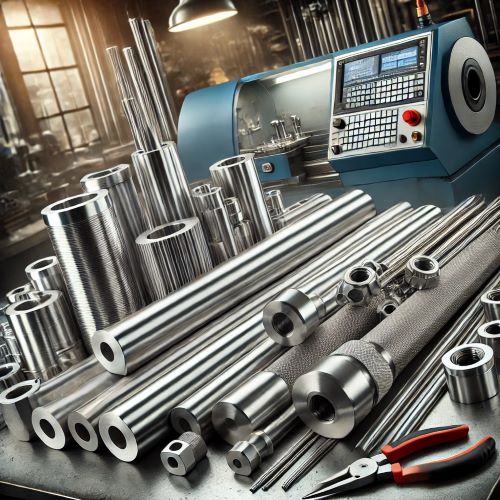
In many CNC machining projects, buyers are not only looking for machining capability, but also consistent quality, clear communication, and reliable delivery.
HFJ provides CNC machining services for both prototyping and production, with a focus on maintaining stable tolerances across different materials and part geometries. With in-house equipment and experienced engineers, we help evaluate part designs and select suitable machining processes to reduce manufacturing risks.
From rapid prototyping to low- and high-volume production, our machining services support a wide range of materials including aluminum, stainless steel, brass, and engineering plastics, commonly used in automotive, electronics, and industrial equipment.
Typical applications include precision housings, shafts, brackets, and custom mechanical components.
CNC Milling for Complex Precision Parts
For complex parts with pockets, cavities, and multi-surface machining.
Commonly used for housings, brackets, and multi-surface components
✔ Suitable for aluminum housings ✔ Multi-axis machining capability ✔ Tight tolerance features
CNC machining is a manufacturing process used to produce precision parts by removing material from solid blocks using computer-controlled equipment.
In many machining projects, CNC machining is selected when tight tolerances, complex geometries, and consistent repeatability are required.
Engineers often rely on CNC machining for components used in automotive, electronics, and industrial equipment, where dimensional accuracy and surface quality are critical.
One common issue buyers face is balancing cost and precision. Proper process selection and machining strategy play a key role in achieving stable quality without unnecessary cost increase.
Our CNC machining capabilities include milling, turning, and secondary processes such as surface finishing to meet different application requirements.
Depending on part geometry and tolerance requirements, different machining methods are selected to achieve the best balance between cost and performance.
Precision CNC Machining Capabilities and Tolerances
Achieving tight tolerances is one of the key requirements in many CNC machining projects.
Engineers often encounter challenges such as deformation, tool wear, and thermal variation when working with precision components.
Our CNC machining capabilities are designed to maintain stable dimensional accuracy across different materials and part geometries.
Depending on part requirements, tolerance levels can vary based on machining method, material properties, and structural design.
For example, thin-wall parts or long shafts require different machining strategies to control dimensional deviation.
Typical tolerance ranges:
• Standard machining: ±0.1 mm • Precision machining: ±0.01 mm • High-precision applications: ±0.005 mm or better
One common issue buyers face is specifying tight tolerances without considering material behavior and machining feasibility.
In many cases, over-tight tolerances can significantly increase cost without improving part performance.
Our engineering team helps evaluate drawings and suggest practical tolerance ranges based on real machining conditions.
Why Engineers Choose Our CNC Machining Services
Selecting a machining supplier is not only about capability, but also about consistency, communication, and problem-solving experience.
01 Consistent Precision Across Production Batches Stable dimensional accuracy from prototype to production.
03 Material Selection Based on Application Requirements Material choices optimized for strength, machinability, and cost.
05 Support for Sub-Assembly and Multi-Part Integration Improved fit and reduced assembly issues before shipment.
07 Industry Experience Machining strategies adapted to different industry requirements.
02 Reliable Lead Time for Prototyping and Production Reduced delays through streamlined communication and processes.
04 Surface Finishing Based on Functional Requirements Finishing processes selected based on performance, not just appearance.
06 Strict Quality Control Inspection focused on critical dimensions and functional features.
Custom CNC Machined Parts for Real Applications
Due to NDA agreements, many custom projects cannot be displayed. The examples below represent typical machining capabilities and part complexity we handle.
5-Axis CNC Machined Aluminum Housing
• Material: Aluminum 6061 • Process: 5-axis CNC milling • Application: Industrial equipment and structural components • Features: Complex geometry with deep cavities and multi-face machining
In many machining projects, parts with complex geometry require multiple setups if using 3-axis machines. 5-axis machining allows better control of accuracy, reduces repositioning errors, and improves overall part consistency.
In many machining projects, long slender parts with repeated features can deform or lose consistency during machining. Process control and proper fixturing are critical to maintain straightness and dimensional stability.
Engineers often encounter challenges with flatness, surface finish, and color consistency in anodized parts. Proper machining strategy and surface preparation are essential to achieve both dimensional accuracy and cosmetic quality.
In many machining projects, maintaining alignment between mating components is critical. Proper control of concentricity and step dimensions helps ensure stable assembly performance.
Precision Small Turned Components
• Material: Aluminum • Process: CNC turning + anodizing • Application: Mechanical fittings and assemblies • Features: Small-size parts with consistent tolerance
Engineers often encounter variation in small parts during batch production. Stable tooling and process control are essential to maintain consistency across quantities.
Stainless Steel Threaded Shafts
• Material: Stainless steel • Process: CNC turning • Application: Shafts and fastening components • Features: Thread accuracy and concentricity control
One common issue buyers face is poor thread fit or inconsistent shaft dimensions. Accurate thread machining and diameter control are essential for reliable assembly.
CNC Machining Materials
Choosing the right material is not only about strength or cost. In many machining projects, material selection directly affects machining stability, tolerance control, and even delivery time. Engineers often encounter situations where a design looks simple, but material choice makes machining difficult or increases cost unexpectedly. At HFJ, we usually review part drawings first, then suggest suitable materials based on geometry, tolerance, and application. Below are some commonly used CNC materials and how they are typically applied in real projects. projects.
Different materials behave very differently during machining. Click below to compare options based on your application.
Metals (Click a material to see machining details)
> Aluminum
> Stainless steel
> Carbon Steel
> Brass
> Aluminum
Aluminum
aluminum cnc machined parts housing
In many CNC machining projects, aluminum is often the first material engineers consider.
It is easy to machine, stable in most conditions, and suitable for parts with complex geometry.
We often see aluminum used in housings, brackets, and structural parts where both weight and machining efficiency matter.
Why engineers choose aluminum: • Good machinability – suitable for complex features and high-speed machining • Lightweight – useful for automotive and electronics applications • Stable surface finishing – anodizing is widely used • Balanced cost for both prototypes and medium-volume production
Common grades: • 6061 – general-purpose, widely used • 7075 – higher strength, but more difficult to machine
⚠️ Machining note: For thin-wall aluminum parts, deformation is a common issue. Toolpath strategy and finishing passes need to be adjusted to maintain tolerance.
HFJ machining insight: In many aluminum projects, tolerance issues are not caused by the material itself, but by part structure. For example, thin walls, large cavities, or uneven thickness can lead to deformation during machining. At HFJ, we usually review the drawing and adjust machining sequence, especially finishing passes, to control deformation and maintain stability.
> Stainless steel
Stainless Steel
SS CNC machined shaft from HFJ
Stainless steel is usually selected when corrosion resistance and strength are both required.
In many machining projects, engineers choose stainless steel for parts exposed to moisture, chemicals, or outdoor environments.
However, compared with aluminum, stainless steel is more difficult to machine and requires more stable cutting conditions.
Why engineers use stainless steel: • Strong corrosion resistance • Good mechanical strength • Suitable for harsh environments
Common grades: • 304 – general corrosion resistance • 316 – better performance in chemical environments
Typical applications: Medical parts, food equipment components, outdoor mechanical parts.
⚠️ Machining note: Tool wear is faster when machining stainless steel. Improper parameters may lead to poor surface finish or dimensional instability.
HFJ machining insight: When machining stainless steel, one common issue is tool wear and heat buildup. In some projects, improper cutting parameters can cause surface hardening, making further machining more difficult. We usually control cutting speed and tool selection carefully to maintain stable machining conditions and consistent surface quality.
> Carbon Steel
Carbon Steel
Steel CNC Machined shafts
Carbon steel is often used when strength is required but corrosion resistance is not critical.
In many cases, buyers choose carbon steel to reduce cost, especially for internal structural parts.
Why it is selected: • Lower material cost compared to stainless steel • Good strength and machinability • Suitable for structural components
⚠️ Machining note: Surface protection (plating, coating) is usually required to prevent rust after machining.
HFJ machining insight: For carbon steel parts, many issues appear after machining rather than during machining. For example, rust or surface oxidation can affect assembly and long-term performance. We often recommend suitable surface finishing such as plating or coating early in the project to avoid rework later.
> Brass
Brass
Brass cnc machined precision components and fittings
Brass is commonly used in precision components where good machinability and surface quality are required.
In many machining projects, engineers choose brass for fittings, connectors, and decorative parts.
Why engineers like brass: • Very easy to machine • Good surface finish without extra processing • Good electrical conductivity
⚠️ Machining note: Brass produces clean chips and stable cutting conditions, which helps maintain tight tolerances.
HFJ machining insight: Brass is one of the easiest materials to machine, but dimensional consistency can still be affected in high-volume production. In some cases, tool wear over time may lead to slight variation in dimensions. We usually monitor tool condition closely and adjust machining parameters during batch production to maintain consistency.
Plastics(Click a material to see machining details)
> Polycarbonate (PC)
> PVC (Polyvinyl Chloride)
> POM (Delrin / Acetal)
> Nylon (Polyamide, PA)
> HDPE
> ABS
> Polycarbonate (PC)
Polycarbonate (PC)
In many CNC machining projects, PC is selected when both transparency and impact resistance are required.
Engineers often use PC for protective covers and housings that need to withstand mechanical stress without cracking.
Why engineers choose PC: • High impact resistance • Good dimensional stability • Transparent material
⚠️ Machining note: PC can melt if cutting parameters are not properly controlled. Surface scratches are also a common issue.
HFJ machining insight: For PC parts with optical requirements, we usually reduce cutting speed and apply polishing or secondary finishing to improve surface clarity.
> PVC (Polyvinyl Chloride)
PVC (Polyvinyl Chloride)
PVC is often used for industrial components where corrosion resistance and cost control are important.
In many projects, PVC is selected for fluid-related applications or chemical environments.
Why engineers use PVC: • Good chemical resistance • Cost-effective material • Easy to machine
⚠️ Machining note: Nylon absorbs moisture, which can affect dimensional stability.
HFJ machining insight: We usually control storage conditions before machining nylon parts to reduce dimensional variation caused by moisture absorption.
> HDPE
HDPE (High-Density Polyethylene)
HDPE is often used for low-load applications where chemical resistance and flexibility are required.
In many projects, it is selected for cost-sensitive plastic parts.
Why choose HDPE: • Good chemical resistance • Lightweight • Low cost
In many CNC machining projects, selecting the right surface finish depends on function, environment, and cost. Some finishes are chosen for appearance, while others are critical for corrosion resistance, wear resistance, or electrical performance. Below are common finishing options and how they are typically used in real applications.
As Machined surface
Surface straight from CNC machining, with visible tool marks.
Best for: • Internal parts or non-cosmetic surfaces • Functional components where cost is critical
Not recommended for: • Visible consumer products • Parts requiring corrosion resistance
Typical roughness: Ra 3.2 – 6.3 μm
Sand Blasted Finish
Creates a uniform matte texture by blasting abrasive media.
Best for: • Removing machining marks • Preparing parts for anodizing
Often used before anodizing to achieve a consistent surface appearance.
HFJ machining insight: For cosmetic aluminum parts, sandblasting + anodizing is one of the most stable combinations for consistent appearance.
Anodized Finish
Creates a protective oxide layer on aluminum parts.
Best for: • Consumer products (electronics housings, enclosures) • Outdoor or humid environments
Common options: • Type II (decorative anodizing) • Type III (hard anodizing for wear resistance)
Anodizing is selected when both appearance and corrosion resistance are required.
One common issue buyers face: Color variation between batches, especially for large parts or mixed alloys.
Powder Coating Finish
A coating applied as dry powder and cured under heat to form a durable layer.
Best for: • Outdoor or industrial applications • Parts requiring strong wear and corrosion resistance • Structural components and brackets
Compared to liquid painting: Powder coating provides a thicker and more durable layer, but may not be suitable for tight tolerance areas.
Not recommended for: • Precision mating surfaces • Thin-walled parts sensitive to heat
HFJ machining insight: In many projects, masking is required before powder coating to protect critical dimensions such as threads or bearing surfaces.
Liquid Painted Finish
Applied by spraying liquid paint and curing to achieve decorative or functional surfaces.
Best for: • Cosmetic parts with color requirements • Consumer products and housings • Parts requiring flexible coating thickness
Compared to powder coating: Painting offers better control for thin coatings and fine details, but is less durable in harsh environments.
One common issue buyers face: Uneven coating or poor adhesion if surface preparation is not properly controlled.
Plating
Plating (Nickel / Zinc / Chrome)
Applies a metal coating to improve surface performance.
Tolerance selection directly affects cost, lead time, and part performance. Below is a practical reference based on typical machining conditions.
Description
General Tolerances
ISO 2768-mK
Precision Tolerances
Precision Tolerances:
Common achievable tolerance is ±0.01 mm.
Tighter tolerances (up to ±0.005 mm) are possible depending on:
- material
- part geometry
- machining method
Cost Impact of Tight Tolerances:
Over-specifying tight tolerances can significantly increase machining time and cost without improving part function.
Maximum Part Size-Milling
Up to 1500 × 800 × 800 mm (X × Y × Z)
Maximum Part Size-Turning
Disc-type parts: up to Ø400 × 300 mm or Ø500 × 100 mm
| Shaft-type parts: up to Ø100 × 750 mm, or Ø300 × 500 mm
Minimum Part Size
CNC Milling: 3*3*3mm
| CNC Turning: Ø1 × 10 mm for shaft
In many machining projects, quality issues are not caused by machining itself, but by unclear tolerances, material instability, or inspection gaps.
Engineers often encounter problems such as: – parts meeting drawing tolerances but failing in assembly – surface finish not matching functional requirements – batch variation between samples and production
At HFJ, we focus on identifying critical dimensions and functional features instead of checking only general tolerances.
Our inspection process includes: – First article inspection before production – In-process inspection on critical dimensions – Final inspection based on functional requirements
If an issue is detected, machining is stopped immediately to prevent batch defects.
In many CNC machining projects, customers work with us when:
• Drawings are incomplete or need engineering review • Tight tolerances are required for assembly • Multiple processes need to be managed together • Consistent quality is needed across batches
We focus on solving real machining and sourcing problems, not just producing parts.
You guys are so smart and professional.
Your efficient and straightforward communication in details of parts save me a lot of time. The assemblies work with our machines very well. Look forward to cooperating again in days to come. Thanks.
Previously, HFJ was supplying me along with 7 other Chinese factories. But after 2017, they are our preferred CNC machining supplier. We placed all our overseas orders to HFJ. They are really patient, attentive and reliable. I am relieved to process my parts here!
I want to express my sincere thanks to you and your team. You did a great job and the machined parts are perfect! Please express my thanks to your logistic team especially, they gather my 14 vendors' products for me and do the integrated optimization job, then combine shipping, which save me so much time and cost! I am lucky to have you be my products' collecting and distributing center from China to USA.
I have an assembled unit involes many processes, e.g. turning&milling parts, stamping cover, rubber washer, customized rivets etc. All these parts require dimensionally very good to highly fit each other. And the most difficult portion is that there is no drawings available! While with this ONLY one sample, HFJ help me disassemble all parts, measure cooresponding dimensions, customize stamping mould, and find proper rivets vendor.....I am placing a trial order for this now, they solve my headache once again as they did years ago for my fuel assembly. I am impressed with your supports, hardworking, efficient commumnication at your late night and weekend, I appreciate all those very much!
Hello, Thank you for checking in. Yes, these fuel caps are made exactly to our specifications and fit our fuel tank perfectly. We plan to make another order soon of 5000pcs. We'll make the handle change for easier grab at that time, will let you know soon when we have drawings updated.
I am very happy with your service again, everything came out great. Packaging was perfect! I want to thank you for paying attention to quality, and communicating with me about the QPQ finish. It’s rare that my feedback is only positive, but you’ve earned it!
If drawings are incomplete, you can still send what you have.
In many projects, customers come to us with early-stage designs. Our engineering team can review the drawing, identify potential issues, and suggest adjustments before production.
Price comparison in CNC machining is not always straightforward.
In many projects, we see that our pricing is typically 20–40% lower than suppliers in North America or Europe, depending on part complexity, tolerance requirements, and material.
However, cost is not only about unit price.
Engineers often face situations where a lower quote leads to: – Rework due to tolerance issues – Delays caused by unclear communication – Inconsistent quality across batches
Our approach is to balance cost and reliability.
We focus on: – Stable machining processes for repeatability – Clear communication during production – Practical engineering feedback before machining starts
Compared to some suppliers who compete mainly on price, we try to avoid unnecessary cost reduction that may affect part performance.
In many cases, a slightly higher machining cost can reduce overall project risk and save time in the long run.
In many projects, customers come to us after facing quality or communication issues with previous suppliers. We try to solve these problems from the beginning, not after production starts.
Yes. Many of our projects involve more than just machining.
Typical combinations include:
CNC machining + surface finishing
Machining + stamping parts
Multi-part assembly
One common challenge buyers face is managing multiple vendors. We help reduce that workload by handling machining, sourcing, and basic assembly in one place.
We reduce delays by confirming key details before production.
Once the order is confirmed, our independent PMC department will organize suitable manufacturing schedules.
And our production team holds meeting every morning to review manufacturing progress as well as discuss problems encountered and look for solutions to ensure schedules are on track.
For your better understanding, we can update you on the manufacturing progress weekly by sending pictures or videos if required.
We file drawings and test reports well in case for future reference, if you find any doubts after receiving parts, please contact us at the very first time, we’ll provide you solutions ASAP.
Import duties depend on your country’s regulations.
We can assist by:
Providing HS codes
Preparing required documents
Import tariffs vary greatly from country to country and depend on the type of imported goods. The commodities of most countries in the world conform to the International Harmonized System (HS) codes, which classify almost all commercially traded goods.
If you are very concerned about this, please let us know the usage, name and HS code (if you know) of the parts, then we’ll pre-check import duty for you.